
To be human means to orient vertically; it is our most fundamental human orientation. We live the majority of our lives in a vertical posture, assuming the advantages and challenges of the evolutionary development of a vertical spine. From infancy on we don’t waste any time trying to get ourselves vertical. Place a baby on his stomach and one of his first movements is to raise his head. He doesn’t stop there. As soon as possible he proceeds to push up, sit up, and stand up.
Yet, integrated vertical standing is not a fixed and rigid state. Rather, it is a dynamic stance that makes continual fine adjustments in gravity. This continual stable motion in our posture and internal organs rouses information in the form of emotions, memories, thoughts and sensations. When our entire posture is set in motion, the organs of our bodies are also set in motion. Our internal organs also have sensory and motor nerves that travel to and from the brain transmitting information and response to movements of the body. “The more viscerally aware, the more emotionally attuned you are,†say the Blakeslees in their book, The Body Has a Mind of Its Own (2007, p. 181).
Imagine standing on a gently moving surface that activates nerves and muscles in the feet and 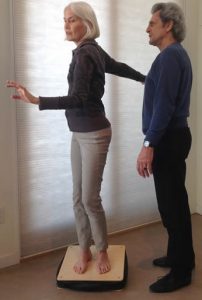

Vertical integration occurs when differentiated structures and the resources of embodiment associate, function in unity, and keep us upright. Siegel (2006) associates vertical integration with the middle pre-frontal area of the brain that enables appropriate physical and emotional response to our relationships and the world around us. Balance and verticality are intimate partners that draw on integration, i.e., all parts working together in harmony. Thus, integration is necessary for creative flow, emotional well-being, and postural motion and stability.
Flow happens as we engage in a living relationship with our imperative need for transformation and growth. The experience of standing on the Tuning Board is not only a biomechanical task that increases someone’s awareness and skill at balancing; it also evokes a symbolic creative imperative of how we manage the polarity of stability and change. However, people get stuck. We get that way because of trauma, injury, aging, conditioned habits, facing difficult choices, and so on. Perhaps we have gotten that way because someone rear-ended us in our car and our body doesn’t move the way it used to. Maybe it happened when we were trying to decide whether to remain in a current job or relationship or to move on to something different. Being stuck feels like we can’t access the creative flow of life and shrinks us away from the world of possibility around us. From a somatic perspective, we become dissociated from our innate interoception, or the ability to sense what is happening in our bodies, thoughts, and feelings.
To read more about Darrell’s work, click here