
Written by Elaine N. Aron, PhD
Reviewed by Nancy Eichhorn, PhD
There are moments—often in the early hours of the morning—when my body is still, my mind is not, and something else quietly observes. Thoughts move in familiar loops; yet alongside them, there is a sense of presence that feels spacious, steady, and not particularly invested in their content. It is not an idea so much as a felt experience—subtle, calm, and difficult to name.
Questions about this observer, and about consciousness more broadly, have motivated my choices of what to read and learn for years. They arise not as philosophical inquiry (though I have reviewed several philosophy books) but as curiosities: Who is noticing? What part of me is aware? What happens when awareness softens the nervous system rather than intensifying it, and I relax and let go?
Like many of my friends and colleagues, I have explored meditation in various forms—guided practices, mindfulness, mantra-based techniques, and sound meditation. I understand the research supporting meditation’s benefits. And friends who have practiced for decades, many of them steeped in Buddhist traditions, speak of meditation as life-changing. But my need to know often left me overwhelmed by the broader spiritual landscape—by complex lineages, historical frameworks, and, at times, teachers whose authority felt questionable. Nothing resonated in daily practice
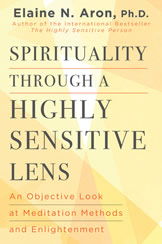
Then, unexpectedly, an invitation arrived to review Elaine N. Aron’s new book, Spirituality Through a Highly Sensitive Lens. I was familiar with the term highly sensitive person, but I hadn’t realized that Aron coined it or that her foundational work, The Highly Sensitive Person, has reached readers in over 30 languages. From the moment I opened this book, I felt a connection. Aron’s voice is calm, thoughtful, and deeply human. Reading, I had the sense of sitting with her over tea, reflecting on life and the many ways we try to understand spirituality and a meditative practice within ourselves. She writes not as a distant expert, but as someone in an ongoing relationship with the material—grounded in both science and lived experience. Aron has practiced Transcendental Meditation (TM) for more than 50 years, and that long engagement shapes the steadiness of her tone.
The book itself emerged during the COVID lockdowns, after Aron was repeatedly asked by the media how highly sensitive people were coping. She admits she wanted to respond honestly: “I don’t know. They are all unique!” Instead of offering simple answers, she began writing. What resulted, five years later, is what she describes as a “sanctuary”—a place for readers to pause, reflect, and discern for themselves what spirituality and meditation might look like, without pressure or dogma.
Early on, Aron acknowledges her own discomfort with the word spirituality; at one point, the book’s working title was “Spirituality or Whatever” (pg. 19). She recognizes its vagueness and its potential for misuse, especially when unexamined beliefs eclipse psychological maturity. Rather than defining spirituality narrowly, she offers a practical and inclusive frame: our capacity to create meaning and connect with what feels essential—whether that is nature, life itself, or an inner source of wisdom. This grounded, psychological orientation runs throughout the book. Aron is less interested in dramatic mystical experiences than in how meditation practice reshapes everyday life over time.
One of the metaphors that stayed with me is Aron’s description of a “supernova” that began when Eastern contemplative traditions arrived in the West in the 1960s—the era when famous people like the Beatles traveled East in search of enlightenment. What began as a dim spark, she suggests, has grown into a widespread shift in human consciousness, resulting in an explosion.
To read the complete review, please click here