Reviewed by Nancy Eichhorn

Hello Out There
She sensed a tap on her shoulder as though it might be real
discerned a distant voice as words crawled in: Hello, are you in there?
Knees tight to chest, hair flopped over eyes, nose, mouth, the young girl peered out, noted an invitation to come forth but didn’t react, not yet.
She sat in dejected silence, dreaded the impending implosion, the decay of a once vibrant soul now swallowing submission by calling it surrender.
There’s more to life than hobbling to other’s ways of being, she thought, more than being squashed between should and must with no room for I want, I need.
She missed the thrill of wild words as they catapulted from within, landed on an exquisite expanse of white, claimed the territory as their own.
A yearning for personal presence plopped down in the emptiness beside her. Was it strong enough to stop this self-imposed invisibility, to twist the key in this self-destruct-mode locked in place as she slid further, deeper into some vacuous space?
A twinge rippled from the ripeness of her belly. Unspoken questions, like fingerlings in spring reaching toward the sun’s light, rose upward, forward: Is there an endpoint? A safe and sacred space for me?
How do I allow myself to exist?
She pushed her hair aside, opened her eyes to face the void. Her lips parted, tentative words formed:
Hello? Are you out there?
(Written in response to reading Writing on the Moon by Nancy Eichhorn)
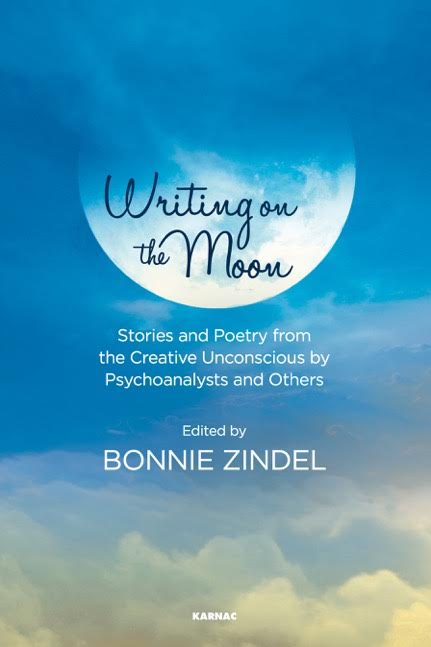
Writing on the Moon: Stories and Poetry from the Creative Unconscious by Psychoanalysts and Others
The title alone prompted my email to Karnac for a reviewer’s copy of Bonnie Zindel’s newest book. Reading the forward cinched it. Bonnie’s skillful use of figurative language was a bit intimidating, okay totally intimidating. How dare I consider writing a review that wouldn’t fall flat, sound dimwitted and dull when juxtaposed to her masterful use of sound, sight, and syllabication. Bonnie’s taken poetic play to heart; here, just read this sentence aloud and you’ll hear what I mean: “thunderbolts strike, flying shadows lurk, golden arrows soar . . .†(pg. xv). We’ve got jagged energy piercing, ghostly apparitions hovering, a savior coming to the rescue. I read the forward twice simply to appreciate the language.
Bonnie’s background is in fact the proving ground for her artistic ability to be within oneself and yet write the experience out loud for you, and me, to partake as deeply and richly as we desire. She didn’t come to all of this spontaneously. Bonnie is a psychoanalyst, a faculty member, supervisor and trainer at the National Institute for Psychotherapy, the founding editor and literary editor for Psychoanalytic Perspectives, an author of numerous books and articles and a playwright—she’s written and produced three plays. This current project took 15 years from start to finish. It started as a call for poems for a new Creative Literary Section she started in Psychoanalytic Perspectives. The response to that initial call left her wondering how to select eight from the thousands of submissions that arrived. Her creative intuition framed questions that determined what went into the journal then and the book now:
Did I respond emotionally to the poem?
Was I moved?
Did it feel original?
Did I want to read it again?
Did the writers allow me into their being? (pg. xviii)
Writing on the Moon is a collection of poems, stories, and artwork previously published in Psychoanalytic Perspectives. Two-thirds of the 29 contributors are psychoanalysts/psychotherapists with extensive and impressive publishing backgrounds. Those who are patients, artists, poets, writers, performers, professors, cartoonists and so forth are also well published and many are award winners, all prestigious awards no less. This is not a collection of random works from people off the street.
One reviewer wrote that this book “pays homage to the wisdom of the unconscious.† Bonnie writes: “The creative unconscious, this estuary of the unknown, is the doorway to our originality. It can surface when we least expect it—translating chaos and feelings from our body into poetry, stories, paintings, and music. Here is the Holy Grail, the unworded and mysterious place, the center of our vitality. Here we are old and here we are new, existing outside of time. It is our truest nature†(pg.xv).
According to statements on the back of the book, the writings meander through unconscious terrain as writers explore how they can be more originally themselves and how they can release the constraints that bind them. They look at why creativity is important to psychoanalysis and how a therapist’s analytic mind can be receptive to the artistic voice. Each of the 17 chapters involves a theme such as: dreams as poetry, a call for love, strong women’s voices, creativity and madness, presence and absence, and outsider art. There’s a chapter dedicated to “The Unexpected Poet: D.W. Winnicott†and one entitled, “Ferenczi and Relationality: On Losing One’s Analyst.â€
Each chapter begins with a forward Bonnie wrote to explain, to introduce. She describes a scene, offers a sense of what you are about to read and why. There’s no prefabricated interpretations of what you are supposed to take away however; instead, Bonnie offers an invitation to experience the contributors’ world, their emotional realities explored in verse and narrative. There are also select quotes and artwork to accompany the text.
There isn’t space, nor need to share every submission. And still, some come to mind like Victoria Pollock’s poem, Psychoanalysis: A Dream. Victoria is a Canadian psychoanalyst and psychotherapist in private practice and an adjunct faculty member at the School of Theology at the University of Toronto. She shared a dream about she and her therapist in response to the theme: Dreams of Poetry. She explains that the poem is about “feeling psychoanalytic intimacy that’s transgressiveâ€. It explores “the thrill of wrong doing yet the truly thrilling experience is working closely together, shoulder to shoulder, head to head, and somehow penetrating each other in ways that feel out of control and ecstatically wrong, but are, in fact, right†(pg. 5).
Psychoanalysis: A Dream
They are sitting on the floor,
They lean hard against each other.
Studying the cell phone,
Too close,
Transgressive,
Their bodies crash together, side by side,
as if it’s not happening at all, but it is.
Longing, balled up tight like paper
tossed in a trash can unfolding.
They are falling into and through each other
with everything they’ve got.
Jim Klein’s narrative falls under Creativity and Madness. Jim has a doctorate in English; he was a professor until asked to leave due to a manic episode. Diagnosed with bipolar disease, Jim offers poetry written while in and out of mental hospitals. “Writing,†he notes, â€is the most powerful therapy†(pg. 45). Letters to Dearest Mother are excerpts from famous writers’ uncensored correspondence to their mothers that speak “eloquently of simply everyday experiences as well as significant emotional moments†(pg. 59). Each author (James Joyce, Margaret Fuller, George Sand, Gustave Flaubert, and Marcel Proust) presents an intimate look at their relationship with their mother, be it painful, longing, reflective, angry, disappointed, rejected and unloved.
The Day of Michelangelo is Bonnie’s story about her experiences traveling in Italy and the revelations that came. Again, her pacing and language, the realizations and experiences held my focus. Chapter Eleven, The unexpected Poet: D. W. Winnicott, offers both insight into this man via background Bonnie provides, as well as a letter to his mother (written when he was 14), a poem he wrote his mother when he was 67, a poem by Masud Khan, Winnicott’s student, analysand and editor, and, finally, near the end of Winnicott’s life, a poem he wrote entitled Sleep:
Sleep
Let down your tap root
To the centre of your soul
Suck up the sap
From the infinite sources
Of your unconscious
And
Be evergreen
The final chapter, Ferenczi and Relationality, offers two powerful narratives. Darcy Dean Minsky, LCSW, writes about Jerry, her analyst and their 21-year connection that ends with his mental decline. And Kabi Hartman, PhD writes about Naming the Absence, exploring the seven-year relationship she had with her analyst (five days a week for seven years) and his sudden death (heart attack). She shares her life at age 21 when she started, their relationship and how her life moved forward in positive directions. Her ability to capture details, to turn a phrase, to bring their relationship to life in the wake of his death are noteworthy.
In Conclusion
So as not to leave you hanging, some sort of summary or wrap up is expected, and yet the entire act feels perfunctory after experiencing these author’s creative explorations. Why artificially bring them to an end when in fact many of their words will continue to seep into my psyche, be with me for days, months, some perhaps even years, coming to mind in spontaneous moments of reflection, connection, being.  In this light, I offer an invitation knowing that my response to this text is clearly that, my response. You will not have the same experience when reading this book (or any other book I review). For some, the content may be lighter, less impactful, for other’s tears may flow or a feeling may come of What’s so great about this? Whatever your experience, it’s all real and true, that’s the beauty of creativity, self-expression and self-exploration. There’s no right, no wrong. It just is. And yet, I do want to invite you to keep Bonnie’s list of questions in mind—the ones she used to guide her intuitive sense of what resonated—when you read these contributions as well:
Did I respond emotionally to the poem?
Was I moved?
Did it feel original?
Did I want to read it again?
Did the writers allow me into their being? (pg. xviii)
I suspect, at one point, the answer will be yes.
